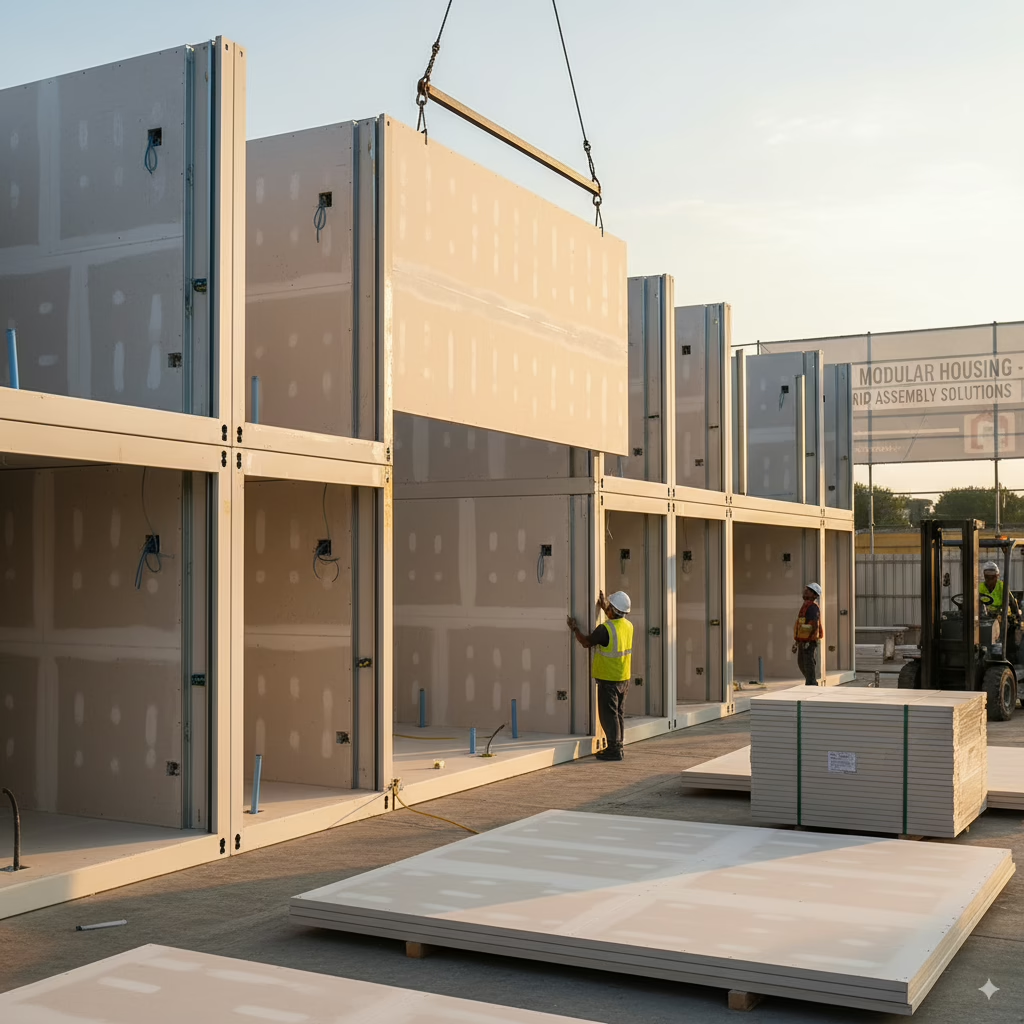
Developers choose modular to build faster, safer, and more predictably. Drywall amplifies those gains. When you design Modular construction Drywall correctly, you reduce waste, compress schedules, and improve finish quality. Furthermore, you standardize assemblies that scale across factories and sites.
Below, you’ll find what works, what to avoid, and how to spec Modular construction Drywall for superior performance.
Why does drywall excel in modular construction?
Drywall thrives in factory workflows. It arrives in standard sizes, finishes cleanly, and integrates with MEP templates. As a result, you hit repeatable quality marks.
Key benefits of Modular construction Drywall:
- Speed: Pre-cut sheets and jig-guided fastening shorten cycle time.
- Quality: Controlled temperature and dust management improve finishes.
- Flexibility: You adapt partitions, soffits, and niches with minimal tooling.
- Cost control: Predictable labor and low material waste protect budgets.
- Compliance: Fire, acoustic, and moisture options meet code with ease.
Explore how we streamline modular scopes on our Services page.
How does Modular construction Drywall compress timelines?
You gain speed in both the plant and on-site assembly.
In the factory
- Pre-measure each module SKU; lock panel cut lists.
- Use screw guns with depth stops for consistent sinks.
- Prefinish to Level 4 or targeted Level 5 in critical areas.
- Tape with automatic tools for uniform joints.
On site
- Ship modules wrapped; protect corners with guards.
- Join modules with finish bridges designed for movement.
- Touch up only seams and connection corridors.
Consequently, you reduce punch lists and accelerate turnover.
Which drywall types fit best in modular projects?
Choose board types to match each zone. This matrix protects performance while keeping SKUs lean.
- Type X (fire-rated): Corridors, unit separations, shafts, and egress paths.
- Sound-attenuating panels: Party walls, bedrooms, hospitality suites.
- Moisture- and mold-resistant: Baths, kitchens, laundry nooks.
- Impact-resistant: Lobbies, schools, and high-traffic corners.
- Lightweight drywall: Ceilings and modules with tight lift limits.
Moreover, double-layer systems increase STC and durability with modest labor adds.
Detailing that makes Modular construction Drywall last
Great modules fail without great details. Use these field-proven tactics.
Head-of-wall and drift
Provide deflection tracks at structural interfaces. Then, seal with fire-rated, flexible caulk to maintain ratings and movement.
Control joints and module seams
Plan control joints on long runs and at module intersections. Therefore, you steer cracks away from visible planes.
Corner and edge protection
Install impact beads at exposed corners. Additionally, back heavy mounts with plywood or steel plates.
MEP coordination
Template electrical boxes, low-voltage chases, and plumbing backs. Label penetrations for fast site connections, then seal for acoustic and fire integrity.
Finishing level strategy
- Level 3: Utility spaces and behind casework.
- Level 4: Living areas, typical offices, hotel rooms.
- Level 5: High-gloss, grazing light, or feature walls.
Learn how our team coordinates these details on About Us.
Acoustic and fire performance in modular systems
Quiet and safe modules lease faster and fail inspections less.
Acoustics
- Stagger studs or use resilient channels.
- Combine mineral wool with double-layer gypsum.
- Seal all perimeters with acoustic sealant.
Fire
- Verify UL-listed assemblies for module-to-module joints.
- Maintain continuous fire blocking around risers and shafts.
- Document head-of-wall details for inspectors.
For tailored assemblies, connect with us via Contact.
Sustainability and waste reduction with drywall
Modular construction Drywall supports green goals. You standardize cuts, reuse offcuts, and recycle clean gypsum. Additionally, many boards feature recycled content and low-VOC compounds. Pair airtight drywall methods with efficient HVAC to reduce loads.
See more sustainable options on our Services page and follow updates on Facebook.
Cost controls that protect your pro forma
- Lock SKUs across projects to leverage volume pricing.
- Bundle board, bead, and compound kits per module type.
- Use takt planning to balance lines and eliminate bottlenecks.
- Prefab soffits and wet-wall backs to reduce site labor.
With Modular construction Drywall, small optimizations add up to major savings.
Common mistakes to avoid
- Mixing finishing levels in the same visual plane.
- Skipping movement joints at module connections.
- Under-specifying impact protection in public zones.
- Leaving penetrations unsealed, which kills STC and ratings.
Prevent these issues early to keep handovers clean.
Final take: build smarter with Modular construction Drywall
Modular thrives on repeatability, precision, and speed. Modular construction Drywall delivers all three—while protecting acoustics, fire ratings, and budgets. Partner with a drywall team that understands factories and field realities.
Visit HD Drywall for project guidance, see our Services, learn About Us, or Contact us to launch your next modular build.